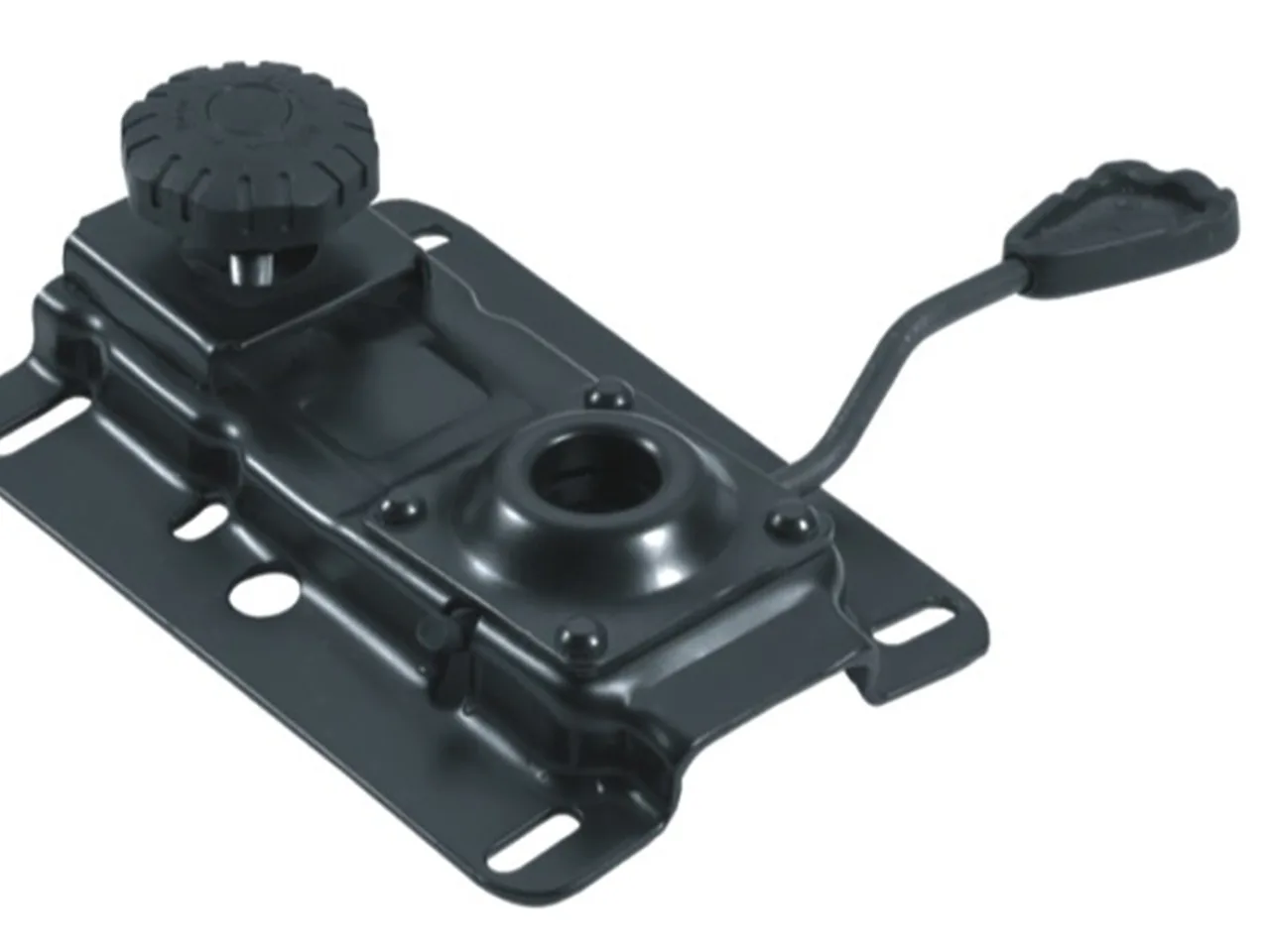
Buyers compare tilt mechanisms on pivot type, lock positions and steel thickness, and then sign off a part where the recline feel is decided by something nobody asked about: the spring. We have shipped two plates with identical geometry where one chair felt composed and the other felt like a catapult, and the entire difference was spring rate and preload. So here is the spring conversation we wish more RFQs started with.
Where the spring sits and what it does
Every free-floating tilt needs a spring that resists the recline and returns the back upright. (How the pivot location shapes the motion is a separate question — we covered that in our synchro vs knee-tilt note, and nothing there changes here.) What the spring controls is the force curve: how hard the back pushes against you at one degree of recline, at ten, and at full stop, and how much of that the user can adjust with the tension knob.
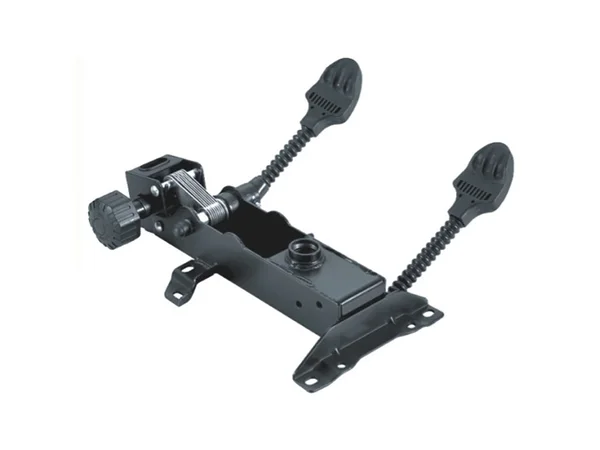
Compression coils: the workhorse
Most of the plates we build, including the ZT-S7 synchro and the ZT-B butterfly, run a helical compression spring — a coil stood vertically or near-vertically in the housing, squeezed harder as the back reclines. Its behaviour is honest and close to linear: force rises steadily with deflection, and the rate is fixed by wire diameter, coil diameter and the number of active coils. The tension knob does not change that rate. It changes the preload — how much the coil is already squeezed before anyone leans back. More preload means a higher breakaway force at the first degree of recline; the slope of the curve stays the same.
That distinction matters when a buyer reports "the tilt feels too soft for heavy users even at maximum tension." Winding the knob further only lifts the starting point. If a 120 kg user runs out of adjustment, the fix is a stiffer spring — thicker wire or fewer active coils — not more knob travel. We keep two or three spring rates tooled per plate family for exactly this reason, and matching the rate to the user-weight class costs nothing at order time. Discovering it after a container has shipped costs rather more.
Torsion springs: the slim option
The second family loads the spring in twist instead of squeeze — a torsion bar or flat spiral packaged around the pivot axis. The practical win is height: without a vertical coil, the housing flattens, which is what makes the slim, low-profile mechanisms under minimalist task chairs possible. The feel is different too. Because the spring acts directly around the pivot, the force builds smoothly from the first degree, with less of the slightly dead then suddenly firm character a high-preload coil can have.
The honest downsides: the adjustment window is usually narrower, because preloading a torsion bar through a user-friendly knob takes more reduction gearing than compressing a coil; the tooling costs more; and when a torsion spring relaxes it is a part replacement, not a knob tweak. A worn coil can be swapped at a service bench in minutes. A torsion bar pressed into a slim housing usually means swapping the mechanism.
Set loss: what year three feels like
Springs do not break in service often. They relax. A spring run too close to its stress limit loses a few percent of its free length or twist over the first seasons of use, and the user experiences that as a chair that slowly leans further back at the same knob setting. The defences are unglamorous: a spring specified with margin below its stress limit, decent wire grade, and shot peening on the higher-duty rates. This is a fatigue question, so cycle testing is the proof — we put our assemblies through the recline cycling described in our BIFMA cycle-testing note, and a spring that has lost its preload by cycle 200,000 fails that test as surely as a cracked weld. We build to BIFMA and EN test methods and testing on your configuration can be arranged.
A note on weight-sensing designs
A third family deserves a sentence: the so-called weight-sensing or self-adjusting mechanisms, which use linkage geometry to scale resistance with the sitter's own weight and reduce the knob to a trim control or delete it entirely. They are elegant, and they remove the one adjustment most office workers never touch anyway. They are also the most linkage-dependent design of the three — more joints, more tolerance stack, more cost — so we only recommend them where the brand explicitly sells "sit down and it just works." For everything else, a well-chosen spring does the same job for less.
The trade-off we put on the table
For a standard task or executive program, a compression coil with the rate matched to your market's user-weight class is the right call: cheap, serviceable, wide adjustment window. Pay for torsion when the chair design demands a thin mechanism profile or when the brand is sold on that smooth first-degree feel — and accept the narrower adjustment and the costlier spare. What we steer buyers away from is speccing the spring by adjective. "Firm but comfortable" appears on a lot of RFQs and means nothing on a force gauge. Tell us the user-weight band and the recline behaviour you want, and we will put a spring rate and a preload range against it.
The plate families and their spring options are in the tilt-mechanism catalogue, and the rest of the chair stack — bases and gas lifts — does not change when you change spring rate, which is the point of keeping the spring inside the plate.
Send us the chair class, the target user weight and how you want the first degree of recline to feel, and we will recommend a spring family and rate with numbers. Reach the engineering desk through the contact form or [email protected].