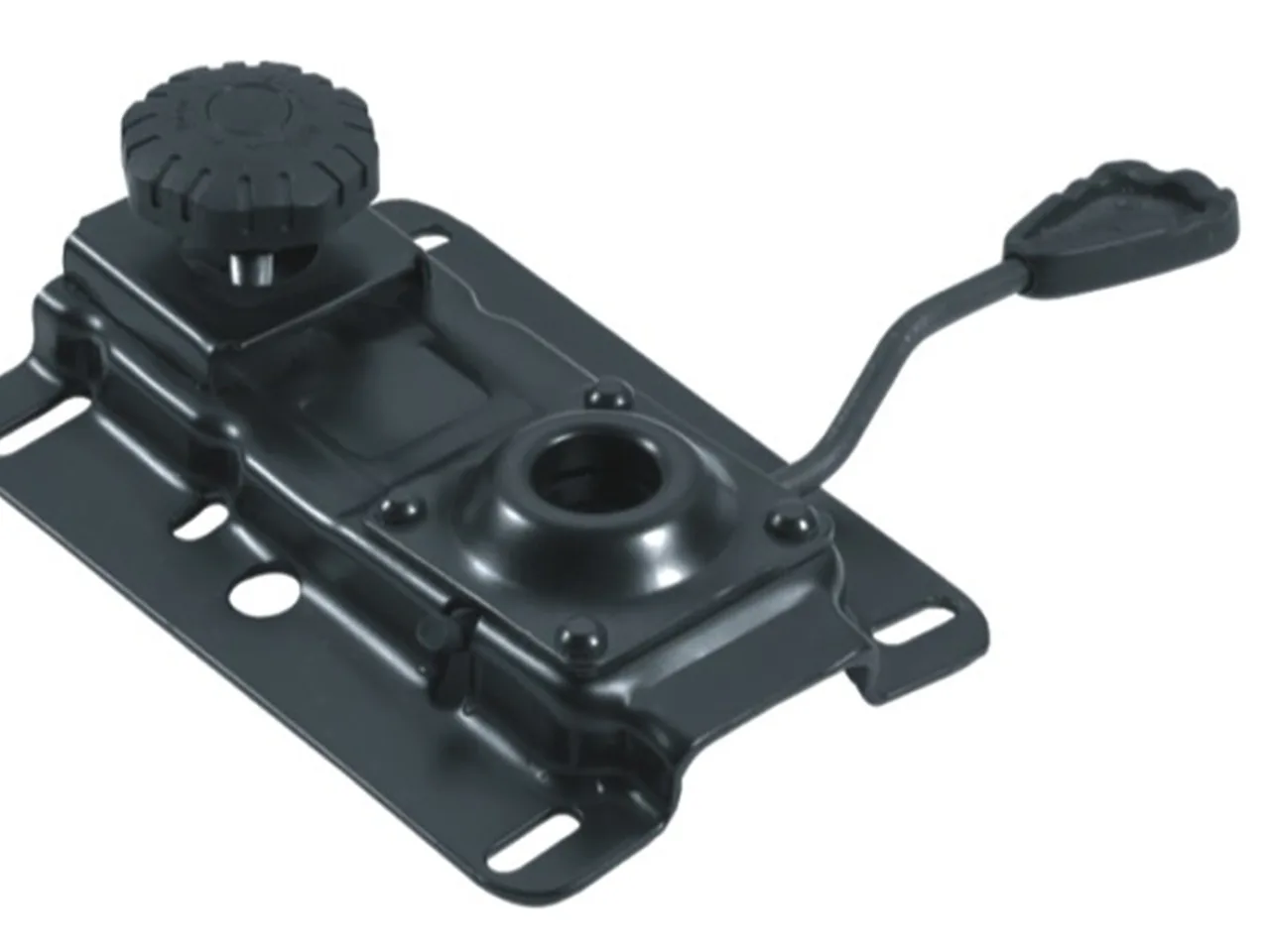
"Is it BIFMA tested?" is the most common question we get and the least precise. ANSI/BIFMA X5.1 is not one pass/fail stamp — it is a battery of structural and cyclic tests, and the seat mechanism sits in the line of fire for most of the cyclic ones. If you sell a component, you live or die on those cycle counts, so it is worth knowing the actual numbers rather than the marketing word.
The cycle counts a mechanism faces
Under X5.1-2017 (reaffirmed 2022), the tests that load the mechanism and base read roughly like this:
- Tilt mechanism test, cyclic — 300,000 cycles. This is the big one for a tilt plate. The chair is loaded (test reports commonly cite 102 kg / 225 lb) and the back is cycled through its recline 300,000 times at 10–30 cycles per minute. The acceptance level is no loss of serviceability — the lock must still lock, the spring must still return.
- Swivel test, cyclic — 120,000 cycles of 360° rotation. This loads the column bore and the bearing race, not just the plate.
- Backrest durability, cyclic — 120,000 cycles (Type II/III). The back is pushed and released against the plate's back-stop and welds.
- Caster / chair-base durability, cyclic — the base and column take a rolling and impact loop (Section 16).
Put together, the mechanism and base see well over half a million load reversals before a chair is allowed to claim compliance. A casting that looks fine on the bench can still open up a weld at cycle 180,000.
What that means for how we build a plate
300,000 tilt cycles is a fatigue problem, not a strength problem. A plate does not usually fail because one push overloads it; it fails because a stress concentration cracks slowly. So on our tilt mechanisms the design effort goes into the boring places: weld length and penetration where the back bracket meets the plate, generous radii instead of sharp internal corners, and 2.5–3.0 mm cold-rolled steel where a cheaper plate would run 2.0 mm. We would rather add a few hundred grams of steel than explain a field crack to a buyer two containers later.
The honest line on certification
Here is the trade-off and the truth. We build our plates to BIFMA and EN test methods, and full cycle testing on your final configuration can be arranged through a third-party lab. We do not pre-print a certificate and call the part "BIFMA certified," because the report is only valid for the exact chair it was run on — your back frame, your foam, your arms. Two suppliers can both say "BIFMA"; only one of them will hand you the report scope and let you read which cycles were actually run. Ask for that scope. Ask us for it too. If you are sourcing finished chairs rather than components, this guide on verifying certification claims walks through exactly what documentation to request and how to read it.
If your buyer needs a report, decide early whether it runs on a representative sample or your production unit, because that changes the timeline — our quality and testing page explains how we schedule it. Compatibility detail (load class, hole pitch, column bore) is on the component catalogue.
Send us the chair class and target user weight and we will tell you which plate clears the cycle counts you need, and what a test booking would look like. Start through our contact form or write to [email protected].