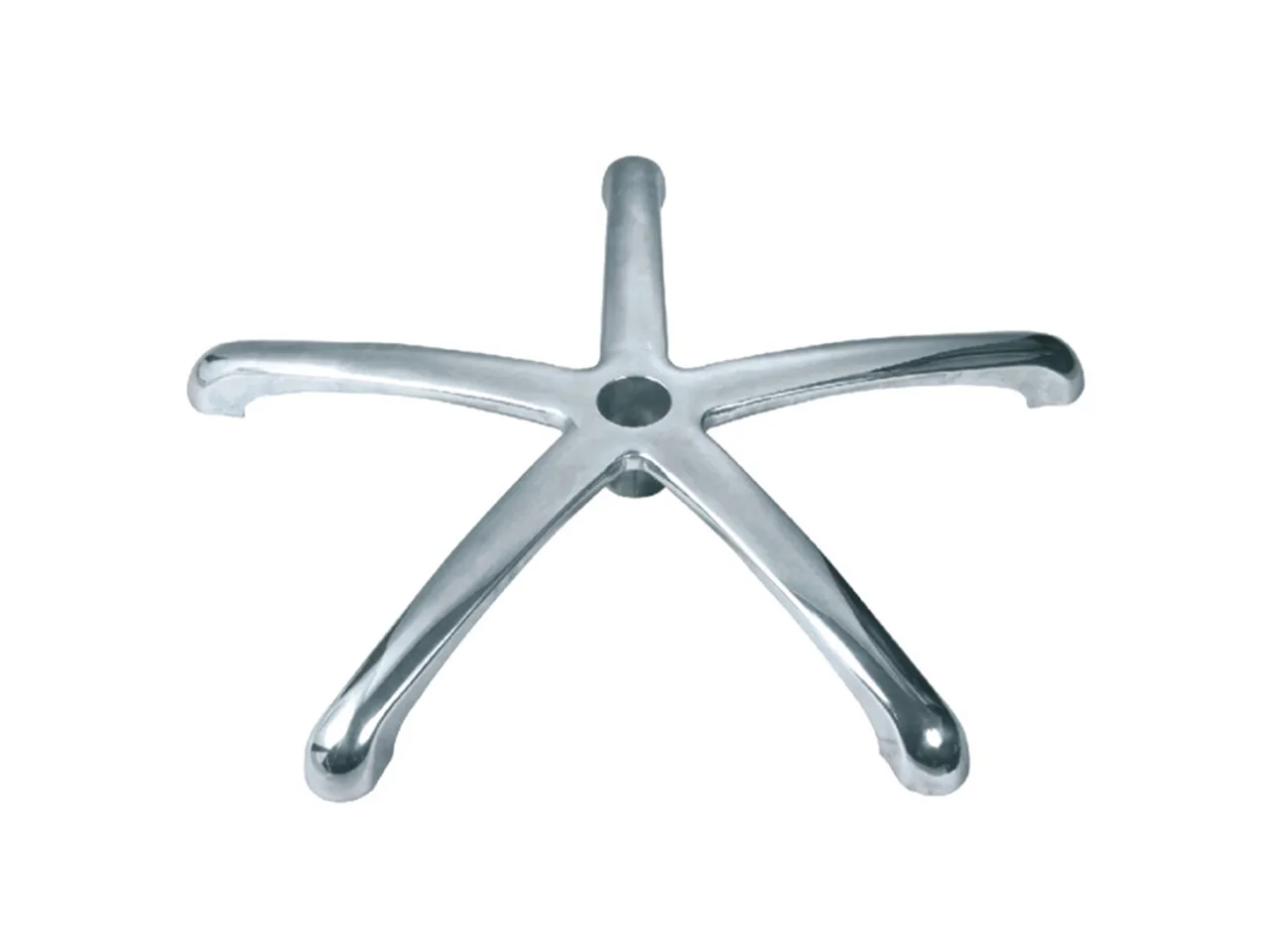
We make five-star bases three ways — pressure-cast aluminium, welded steel and glass-filled nylon moulding — and the question buyers should ask is not "which is strongest" but "how does each one fail, and can I see that failure before it ships." Every process has a signature defect. If you know it, your incoming inspection finds it; if you do not, your customer finds it for you.
Cast aluminium: watch for porosity
Our ADC12 base is pressure die-cast. Molten aluminium is forced into a steel die, so the arms come out as one continuous piece with no joints — that is the strength of the method. The signature defect is porosity: gas trapped as the metal solidifies, leaving voids inside an arm that you cannot see from outside. A porous arm passes a static push and then cracks at that void under cycling. We control it at the casting parameters and catch it with X-ray or sectioning on samples, plus a polished-surface check, because porosity often shows as pinholes after polishing. Ask a base supplier how they check for porosity; the answer tells you a lot.
Welded steel: watch for penetration
A welded steel base joins five tube arms to a central hub. Done right, it is the toughest base we make and the one we send into genuinely heavy-duty and 24/7 seating. The signature defect is weld penetration — a weld that looks fine on the surface but did not fuse deep into the joint. That cold weld holds on the bench and tears open under fatigue at the hub, exactly where the load concentrates. We control it with fixed weld parameters and destructive break tests on production samples; a good supplier will show you a sectioned weld, not just a tidy bead.
Moulded nylon: watch for knit lines and the glass
The nylon base is injection-moulded PA6 with 30% glass fibre. Its signature weakness is the knit line — the seam where two flows of melt meet around the column boss and fail to fully bond, leaving a plane of reduced strength. The other variable is the glass percentage itself: drop it to cut cost and the arm gets noticeably more flexible, which is how a "nylon base" quietly becomes a weaker base without anything visible changing. We hold the glass loading and the mould temperature, and we cycle-test sample bases rather than trusting the static number.
The trade-off and the takeaway
Cast aluminium gives you the best stiffness-to-look ratio; welded steel gives you maximum toughness for heavy duty; moulded nylon gives you the lowest cost and weight. There is no universally "best" process — there is the right one for the user weight and the price point, paired with the right inspection. Whatever you buy and from whomever, tie the order to a process-appropriate check: X-ray or section for cast, weld break for welded, cycle test for nylon. We build and test to BIFMA leg and drop methods and can arrange third-party testing per order, as set out on our quality page.
Tell us the duty and finish you need and we will recommend the process, quote it, and tell you exactly what we will inspect. Reach us through the enquiry form or [email protected]. See the base range on the catalogue or read our aluminium vs nylon comparison.