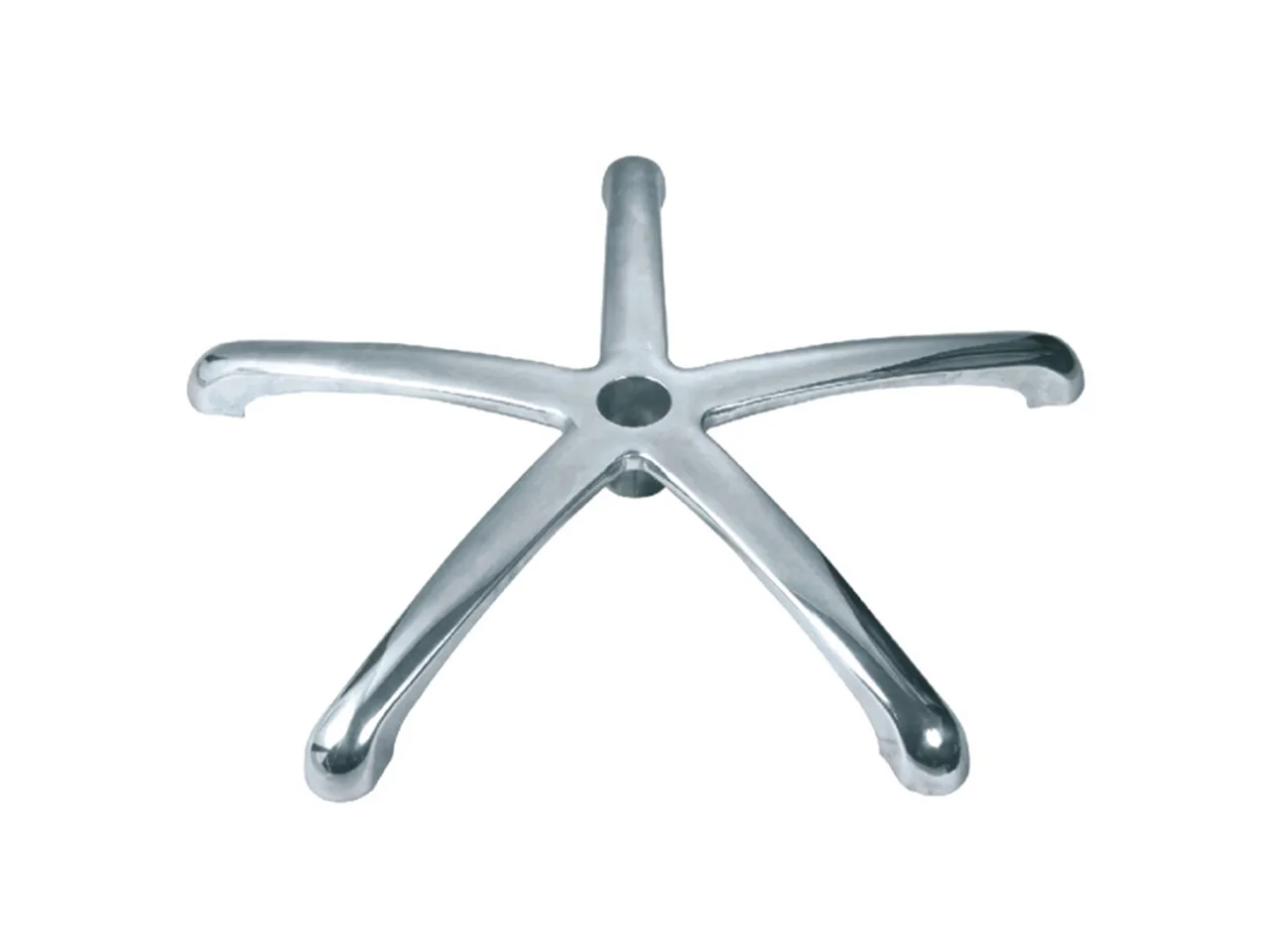
A five-star base looks like the simplest part on a chair. It is also where a surprising number of warranty claims start, because the base carries the whole load through five thin arms into five small caster sockets. Pick the wrong material for the duty and the arms flex, the sockets crack, or the whole thing fatigues out at the cycle test. We cast aluminium and we mould nylon, so we have no reason to push one over the other — only to match it to the chair.
How each material carries load
Our nylon base is injection-moulded PA6 with 30% glass fibre. The glass is what makes it structural rather than just plastic — it stiffens the resin and holds the arm shape under a seated load. It is light, it will never corrode, and it is the most cost-effective base we make. Its limit is flex: under a heavy user, and over years of cycling, a nylon arm deflects more than an aluminium one, and that flex is what eventually shows up as a stress whitening line or a cracked socket.
Our ADC12 cast-aluminium base is heavier and costs more, but it resists cracking and structural fatigue far better and it barely flexes under load. That stiffness is why a polished aluminium base feels "solid" when you rock the chair — the wobble a buyer notices on a showroom floor is usually arm flex, not a loose caster. Aluminium also takes a polish or powder coat that nylon cannot match for an executive look.
The number that decides it
The deciding spec is the rated user weight against the duty cycle, not the static maximum. A nylon base will pass a one-time static load far above its sensible service rating; the question is whether it survives 100,000-plus load reversals with a 110–130 kg user. For standard task and home-office chairs with an average user, nylon is genuinely fine and we ship a lot of it. For heavy-duty, big-and-tall, or 24/7 seating, we move you to a 700 mm aluminium base, and we will tell you the unit cost goes up — because the alternative is paying for it twice when the nylon arms give out.
The trade-off, plainly
Nylon wins on price, weight and corrosion. Aluminium wins on stiffness, fatigue life and finish. Span matters too: a wider base is harder to tip, so for a tall executive back we lean to the 700 mm aluminium not only for strength but for stability under recline. The mistake we steer buyers away from is putting a budget nylon base under a premium high-back — the chair tips and flexes in a way that undoes everything you spent on the upholstery.
All our bases use the same Ø50 column taper, so you can run aluminium on your premium line and nylon on the budget line without changing your gas lift or your mechanism. We build and test bases to BIFMA leg and drop methods; testing can be arranged per order, and the detail sits on our quality page.
Tell us the user-weight class and the look you are after and we will quote the right base in both materials so you can see the delta. Reach us through the enquiry form or [email protected].