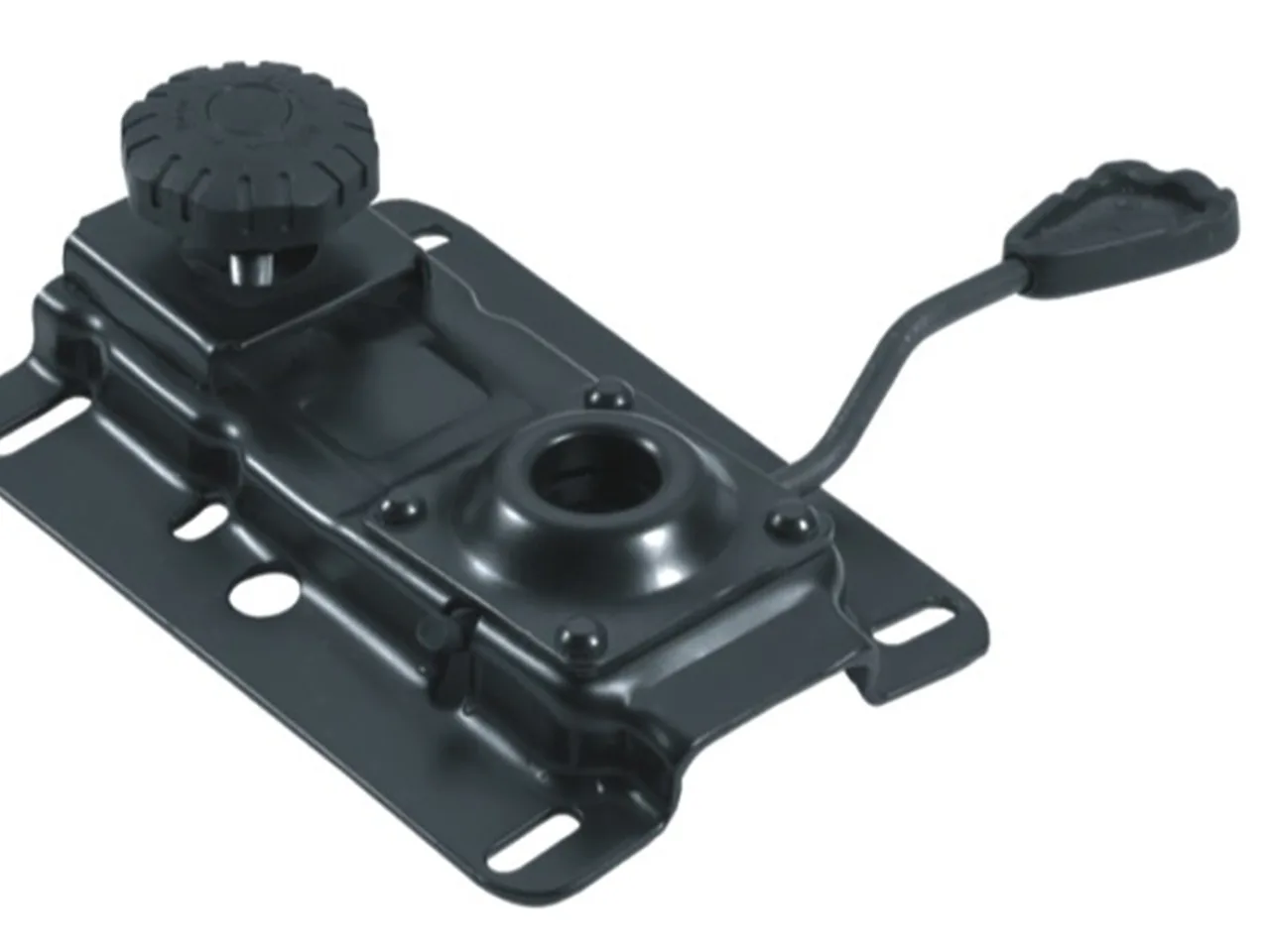
Most of the back-and-forth in a mechanism order is not about quality. It is about fit. A chair factory has tooling, jigs and an assembly line built around a specific seat board and back frame, and the fastest way to blow a delivery date is to order a plate that needs the seat re-drilled. After years of shipping tilt plates to assemblers, we can tell you the order goes smoothly when four numbers are nailed down before anyone talks price.
The four specs that decide fit
- Mounting hole pitch. This is the pattern of bolt holes that fix the plate to your seat board. It is the number-one cause of "the part doesn't fit." Plates are sold by their pitch — quoted in mm pairs like 200×200 or 160×200, or in the inch pairs you will see on replacement parts (6"×8.6", 4.25"×7"). Measure your existing seat board and give us that pitch; if you want a new pattern, send the board drawing.
- Column bore and taper. The plate has to accept your gas lift. Almost the whole industry runs the Ø50 outer column on a standard taper, which is why bases, lifts and plates interchange — but confirm it, because a non-standard bore strands your inventory.
- Load class. Match the plate steel and weld to the user weight and the cycle duty (see our note on BIFMA cycle counts). A 2.0 mm budget plate and a 3.0 mm knee-tilt are not interchangeable just because the holes line up.
- Lever and knob side. Trivial until it is wrong. Tell us which side the lock lever and tension knob sit, and whether the user reaches them seated. Re-handing a plate after tooling is slow.
The sample-before-MOQ rule
We always recommend one fit sample before committing to a production quantity, even when the spec sheet looks perfect on paper. A plate can match every number and still foul your back bracket by two millimetres. A sample costs a little time; a wrong container costs a season. Our OEM process runs a fit sample and, where needed, a test booking before the main run, so the surprises happen on the bench, not at the port. For a buyer-side view of why this step matters regardless of supplier, this sampling-before-production guide covers what to check on a mechanism sample before you commit to volume.
The trade-off on customisation
Here is the honest part. A fully custom plate — your hole pattern, your lever layout, your private-label knob — is absolutely doable, and for a chair that defines your brand it is worth the tooling. But it carries a higher MOQ and a longer lead time than pulling from our standard 7-series plates. For most lines, the smarter move is to design your seat board around a standard plate pitch and spend your tooling budget where the customer actually sees it. We will say so even though the custom job is the bigger order for us.
Send your seat-board drawing, the column bore you run today and the user-weight class, and we will tell you which standard plate drops in and where a small change avoids custom tooling. Reach the engineering desk via the enquiry form or [email protected]. Specs and part numbers are on the component catalogue.